Eccentric Preachers by Charles Spurgeon
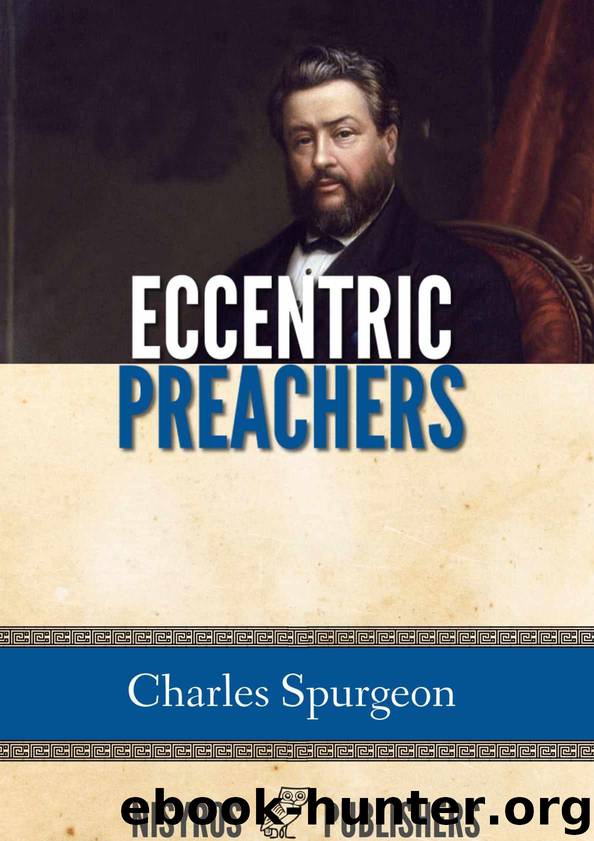
Author:Charles Spurgeon
Language: eng
Format: azw3
Tags: RELIGION/Christian Ministry/Preaching
Publisher: Nisyros Publishers
Published: 2014-09-28T16:00:00+00:00
Rowland Hill, 1744-1833
IT IS NOT OUR DESIGN to write a life of Rowland Hill, but merely to sketch an outline portrait from the “eccentric” point of view. As a preacher Mr. Hill was the child of John Berridge, whose church he attended while he was a student at Cambridge, riding over to Everton every Sabbath to hear him. From that veteran he no doubt learned that freedom and simplicity of language which always distinguished him. He also associated much with John Stittle, one of Berridge’s converts, and a man of very marked individuality, who preached in Green Street, Cambridge for many years. Their intimacy may be gathered from the incident recorded by William Jones:—"On one occasion, when Mr. Hill was on his way to Duxford, to preach for the Missionary Society, he suddenly exclaimed, ‘I must go to Cambridge, and see the widow of an old clergyman, who lives there, for I have a message to leave with her.’ He was urged not to go, but he was firm to his purpose. He spent a short time with the venerable widow, and reached Duxford just before evening service. On entering his friend Mr. Payne’s house he said,’ Dear me, I quite forgot to leave the message with the widow,’ and seemed almost determined to return to Cambridge. He, however, remained during the service, and on being asked whether the message he had forgotten was important he replied, ‘Yes, sir, I wanted the old lady, who will soon be in heaven, to give my love to Johnny Stittle, and tell him I shall soon see him again.’”
Mr. Hill’s first preachings were of an itinerant character. He was glad of a church, and equally delighted with a meeting-house; but the village green, a barn, an assembly room, or a hovel were all used as they were offered. He was not reared in the lap of luxury as a preacher, nor was he surrounded by the society of unmingled aristocracy, so as to be guarded from every whiff of the air of common life. He mingled so thoroughly with the people that he became the people’s man, and for ever remained so. With all the highmindedness which ought to go with nobility he mingled an unaffected simplicity and benevolence of spirit, which made him dear to persons of all ranks. He was thoroughly a man, thinking and acting for himself with all the freedom of a great emancipated mind, which bowed only at the feet of Jesus; but he was essentially a child-man, a Nathanael in whom was no guile—artless, natural, transparent, in all things unaffected, and true. He once said of a man who knew the gospel but seemed afraid to preach it, “He preaches the truth as a donkey munches a thistle—very cautiously:” this was exactly the opposite of his own way of doing it.
His fixed places of ministry were Surrey Chapel, and Wotton-under-Edge. He facetiously styled himself “Rector of Surrey Chapel, Vicar of Wotton, and Curate of all the fields and lanes throughout England and Wales.
Download
This site does not store any files on its server. We only index and link to content provided by other sites. Please contact the content providers to delete copyright contents if any and email us, we'll remove relevant links or contents immediately.
Waking Up in Heaven: A True Story of Brokenness, Heaven, and Life Again by McVea Crystal & Tresniowski Alex(37925)
Still Foolin’ ’Em by Billy Crystal(36468)
Cecilia; Or, Memoirs of an Heiress — Volume 1 by Fanny Burney(32720)
Cecilia; Or, Memoirs of an Heiress — Volume 2 by Fanny Burney(32088)
Cecilia; Or, Memoirs of an Heiress — Volume 3 by Fanny Burney(32065)
Fanny Burney by Claire Harman(26722)
Empire of the Sikhs by Patwant Singh(23202)
We're Going to Need More Wine by Gabrielle Union(19168)
Hans Sturm: A Soldier's Odyssey on the Eastern Front by Gordon Williamson(18724)
Plagued by Fire by Paul Hendrickson(17537)
Out of India by Michael Foss(17022)
All the Missing Girls by Megan Miranda(16694)
Cat's cradle by Kurt Vonnegut(15555)
For the Love of Europe by Rick Steves(14904)
Pimp by Iceberg Slim(14793)
Molly's Game by Molly Bloom(14258)
Bombshells: Glamour Girls of a Lifetime by Sullivan Steve(14217)
Leonardo da Vinci by Walter Isaacson(13508)
4 3 2 1: A Novel by Paul Auster(12611)
